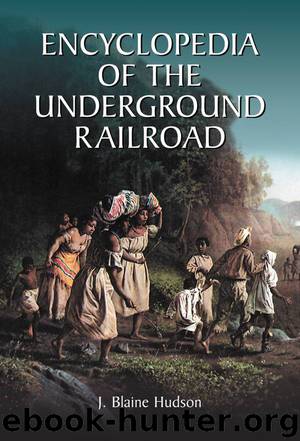
Encyclopedia of the Underground Railroad by J. Blaine Hudson
Author:J. Blaine Hudson [Hudson, J. Blaine]
Language: eng
Format: epub
Tags: General Fiction
Publisher: McFarland
Published: 2012-09-20T16:00:00+00:00
FURTHER READING
Fletcher, Robert S. “The Government of the Oberlin Colony.” The Mississippi Valley Historical Review 20 (1933): 179–190.
Fletcher, Robert S. A History of Oberlin College from Its Foundation through the Civil War. Oberlin, OH: Oberlin College, 1943.
Oberlin-Wellington Rescue (1858)
The last significant fugitive slave rescue case of the 1850s. In September 1858, John, who fled John G. Bacon of Mason County, Kentucky, was discovered at Wellington, Ohio. Ironically, John was identified accidentally by a slave-catcher, Anderson D. Jennings, who had traveled to nearby Oberlin, Ohio, in search of another fugitive. In hopes of profiting from this accident, Jennings contacted Bacon and was given authorization to act as Bacon’s agent under the provisions of the Fugitive Slave Act of 1850.
Jennings obtained a warrant for John’s arrest and, after decoying John out of town, captured and imprisoned him in a tavern in Wellington to await the arrival of a train for Columbus, Ohio. When the residents of Oberlin, a staunch antislavery stronghold, learned that John had been kidnapped, many armed themselves and hastened the nine miles to Wellington, where they freed John by force and spirited him to Canada in a wagon.
As with other noted fugitive slave rescue cases of the later 1850s, John’s escape was, perhaps, less dramatic than the events triggered by his rescue. Such blatant and open defiance of federal law embarrassed the federal government, and the federal grand jury in Cleveland moved quickly to indict 37 persons for violating the Fugitive Slave Act. Those indicted included Charles Mercer Langston, one of the most important young black leaders of his generation; Simeon Bushnell, a store clerk who drove the escape wagon; the Reverend Henry Peck, a faculty member at Oberlin College; and the Reverend James M. Fitch, a missionary.
Some of the accused posted bonds in December. Others remained in jail under protest until the trials began in April 1859. The letter of the law was clear and each defendant was convicted, fined and sentenced to a short term in jail. However, the defendants maneuvered the court into trying each of them individually, with a new jury, which slowed the proceedings and kept the pubic issue alive. Finally, a compromise was reached by which all charges were dropped. The rescuers were hailed as heroes when they returned to Oberlin.
Download
This site does not store any files on its server. We only index and link to content provided by other sites. Please contact the content providers to delete copyright contents if any and email us, we'll remove relevant links or contents immediately.
| Anthropology | Archaeology |
| Philosophy | Politics & Government |
| Social Sciences | Sociology |
| Women's Studies |
Cecilia; Or, Memoirs of an Heiress — Volume 1 by Fanny Burney(32562)
The Great Music City by Andrea Baker(32022)
Cecilia; Or, Memoirs of an Heiress — Volume 2 by Fanny Burney(31959)
Cecilia; Or, Memoirs of an Heiress — Volume 3 by Fanny Burney(31945)
We're Going to Need More Wine by Gabrielle Union(19052)
All the Missing Girls by Megan Miranda(16047)
Pimp by Iceberg Slim(14520)
For the Love of Europe by Rick Steves(14161)
Bombshells: Glamour Girls of a Lifetime by Sullivan Steve(14081)
Norse Mythology by Gaiman Neil(13376)
Talking to Strangers by Malcolm Gladwell(13376)
Fifty Shades Freed by E L James(13247)
Mindhunter: Inside the FBI's Elite Serial Crime Unit by John E. Douglas & Mark Olshaker(9347)
Crazy Rich Asians by Kevin Kwan(9297)
The Lost Art of Listening by Michael P. Nichols(7508)
Enlightenment Now: The Case for Reason, Science, Humanism, and Progress by Steven Pinker(7316)
The Four Agreements by Don Miguel Ruiz(6769)
Bad Blood by John Carreyrou(6626)
Weapons of Math Destruction by Cathy O'Neil(6284)
